
Your AI investment is at risk - and your dashboards won’t show it until it’s too late
Most organizations discover adoption problems after capital, credibility, and momentum are already committed. AIRE gives you early visibility into the conditions that determine whether your AI investment scales — or stalls at 20–40% adoption.
THE LEADERSHIP BLIND SPOT
Leaders and workers are experiencing AI adoption in two different realities.
In a recent survey of 5,000 white-collar workers from companies with 1,000+ employees, the gap between executive and frontline experience was striking:
40%
of non-management workers report saving no time at all with AI
38 ppt divergence
2%
of C-suite say the same
Source: Section/WSJ, 2026
Leaders are excited and productive. Workers are anxious and overwhelmed. And early metrics don't reveal the difference — until it's too late to course-correct cheaply.
The pattern is recognizable - and expensive.
WHAT HAPPENS WITHOUT EARLY VISIBILITY
The pilot performs well. Training completion is high. Leadership is optimistic. Early adopters are enthusiastic.
Early weeks: Deployment success.
Usage is lower than expected - 20-30%. No clear diagnosis of why. Leaders debate: scale, pause, or retrain?
Weeks later: Adoption plateaus.
Teams are retrained on the same tools. Change management playbooks are applied. Still no root cause identified. Costs escalate, timelines slip.
Months later: Reactive response.
The board asks for an ROI explanation. Future AI investments face scrutiny. Leadership credibility is at stake.
Eventually: The accountability moment.
AIRE measures the psychological and organizational barriers in the early weeks — before they cascade into budget pressure and loss of control.
WHAT AIRE ACTUALLY MEASURES
The diagnostic gap no one else fills.
Change management addresses symptoms. Engagement surveys measure satisfaction. AI training programs assume psychological readiness already exists. None of them measure the human and organizational conditions that determine whether people can adopt AI productively. For a midmarket organization, that blind spot is the difference between an AI investment that compounds and one you have to write down.
AIRE fills that gap by measuring four upstream conditions required for AI value to scale:
-
Is AI perceived as a threat to expertise, status, or professional identity? Are people confident enough to experiment?
-
Do people have the cognitive capacity to absorb a new way of working? Or are they already at the breaking point?
-
Do people believe AI will actually help them do their work? Or does it feel imposed and irrelevant?
-
Are managers equipped to lead AI-enabled work? Is there psychological safety to struggle, ask questions, and learn publicly?
HOW ENGAGEMENTS WORK
Three ways in - from signal check to full diagnostic
ENTRY POINT
Power Hour
A focused starting point before a full diagnostic
Want to pressure-test what you're seeing before committing to a full diagnostic? A Power Hour is a one-on-one session where we look at your adoption patterns, team dynamics, and where things feel stuck — and identify whether a deeper diagnostic is the right next step.
Best for: Leaders exploring fit, or building internal buy-in before a larger engagement.
CORE DIAGNOSTIC
AIRE Pilot
Flat-fee diagnostic. Up to 150 seats.
A rapid sprint that deploys the full AIRE diagnostic — mixed-methods assessment, adaptive capacity heat map, barrier identification by role and function, and a targeted intervention roadmap with executive ownership assigned.
Diagnose (Wks 1-3):
Rapid workforce signal capture
Synthesize (Wk 4):
Risk concentration + primary constraint.
Activate (Wk 5):
Executive roadmap + ownership
Best for: Organizations with an AI rollout underway where adoption is uneven and no one can clearly explain why.
FULL SCALE
Full Deployment
Per-seat pricing for larger deployments.
Full AIRE diagnostic across business units, geographies, or entire workforce populations. Modular design allows the assessment to be tailored — a universal baseline plus optional targeted modules for identity threat, governance concerns, social climate, or workflow integration.
Best for: Large-scale AI transformations where uneven adoption has material financial and governance impact.
What people say vs. what’s actually happening
FROM SURFACE SIGNALS TO ROOT CAUSE
-
What’s driving it:
Identity Threat - If AI does my job, what makes me valuable? What happens if my expertise doesn’t count anymore?
What to do:
Reframe AI as augmentations; emphasize judgment and creative work AI can’t replicate.
-
What’s driving it:
Autonomy erosion - I was forced to use this. No one asked what I need.
What to do:
Co-design workflows; let people shape how tools fit their work.
-
What’s driving it:
Cognitive Overload - I’m judged on output. Experimenting costs me.
What to do:
Protected learning time; temporarily adjust performance metrics
-
What’s driving it:
Psychological safety gap - Admitting I struggle will make me look less capable.
What to do:
Manager enablement; normalize learning, experimenting, and making mistakes publicly
This is what makes AIRE different from a survey. It translates surface-level signals into root cause constraints — and maps each one to a specific intervention.
The technology and training are necessary, but insufficient if people can’t absorb the change.
THE BUSINESS CASE
Corporate AI training programs run six and seven figures. Replacing a knowledge worker costs 50–200% of their annual salary. And right now, most organizations have no early signal for whether that investment will translate into sustained adoption — or bounce off a workforce that isn't positioned to absorb it.
AI value is constrained upstream before adoption metrics or ROI dashboards change. Early pilot success creates false confidence about scalability. Adoption friction surfaces only after capital is committed. Leaders lack early signals in the period that matters most.
Converting even 10% of your non-adopters in roles where AI matters most into capable AI users changes the math on your entire transformation investment.
AIRE gives you that visibility — in weeks, not quarters.
Executive-ready deliverables - not a data dump.
WHAT YOU RECEIVE
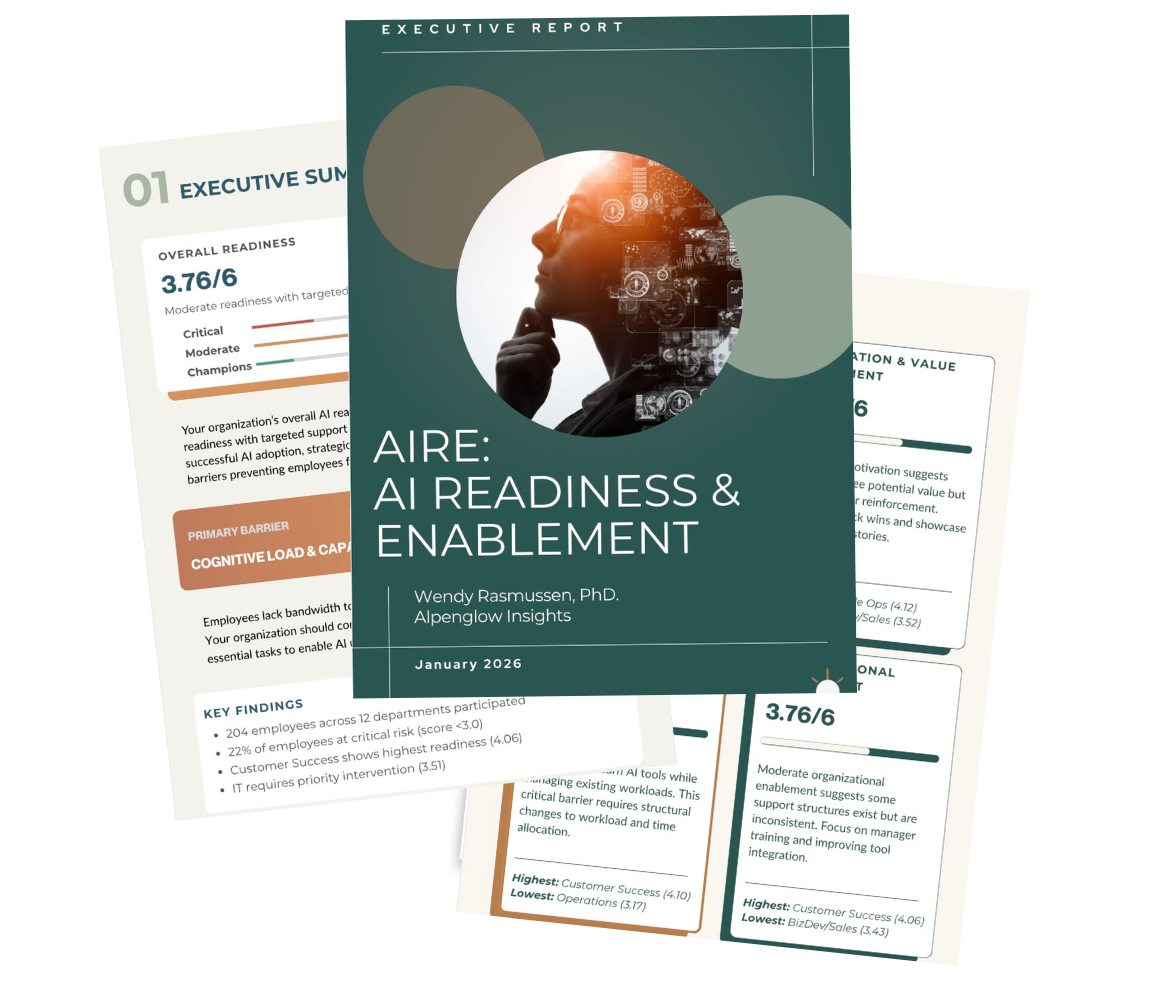
Executive summary with overall readiness score
Domain analysis across all four measurement areas
Primary barrier identification with root cause narrative
Department-level heat map showing where adaptive capacity is concentrated and where constraints are active
Strategic priorities tied to the constraints that matter most
90-day implementation roadmap with ownership assigned